Thursday, June 6, 2024

What are Stand-alone Item Types in Next Generation NCLEX NGN? With Sample Questions and Answers


Stand-alone (single) items test either client needs or clinical judgment. 

Client needs items are primarily traditional NCLEX style questions.

Clinical judgment items present information in a clinical scenario specifically targeting one or more NCSBN Clinical Judgment Measurement Model (NCJMM) clinical judgment step. The NCJMM uses an evidence-based method for measuring and deriving valid inferences around the nursing clinical judgment and decision-making ability of prospective entry-level nurses.

Clinical judgment stand-alone items make up approximately 10% of stand-alone items. 


2 Types of Stand-alone Items: 

1. Bow-tie 

2. Trend 


The Bow-tie Stand-alone Item

   A bow-tie is a drag-and-drop response item variation. After reading a clinical scenario, candidates move response options (tokens) to placeholders (targets). On NCLEX the placeholders are arranged in the shape of a bow-tie. Candidates must select: 1 condition the client is most likely experiencing from 4 options. 2 actions to take to address the condition from 5 options. 2 parameters to monitor the client’s progress from 5 options.

The Trends Stand-alone Item

Trend items require the candidate to make clinical judgments based on client data presented at different time points. Trend items may address one or more clinical judgment steps but do not follow the six-item sequence like case studies do. Trend items can feature any item response type except the drag-and-drop bow-tie variation.  


Sample Next Generation NCLEX Bow-tie Stand-alone Item Questions and Answers:


The 16-year-old client is seen in the emergency department for evaluation of fainting episodes.


Drag and drop items into groups. Within each group, rank items by dragging and dropping them into place.

Items

  • Dehydration
  • Hypoglycemia
  • Severe anemia
  • Shock

Condition most likely experiencing


Drag and drop items into groups. Within each group, rank items by dragging and dropping them into place.

Items

  • Potassium supplementation
  • Glucagon
  • Blood transfusion
  • Oxygen 2L via NC
  • IV fluid*

Actions to Take


Drag and drop items into groups. Within each group, rank items by dragging and dropping them into place.

Items

  • Urine output
  • Point of care blood glucose
  • Electrolytes*
  • Pulse oximeter
  • Hemoglobin/hematocrits

Parameters to monitor


ANSWERS TO THE NCLEX NGN BOW-TIE STAND ALONE ITEM QUESTIONS
  From the list of choices drag the 1 condition that the client is most likely experiencing to the box on the right.
image.png


 Drag 2 actions the nurse should take to address that condition to the box on the right.

image.png
 Drag 2 parameters the nurse should monitor to assess the client’s progress to the box on the right. 

image.png

Sample Next Generation NCLEX Trends Stand-alone Item Questions and Answers:

The nurse is caring for a 74-year-old woman admitted to a rehabilitation unit.


The nurse reassesses the client the next morning.
For each possible finding, click to specify if the finding indicates that the client’s status has improved, declined, or is unchanged. Each row must have 1 option selected.


ANSWERS TO THE NEXT GEN NCLEX TRENDS STAND ALONE ITEM QUESTION:


I hope this article helps future NCLEX NGN test-takers get familiarized with the NGN exam questions. I will be posting more NGN exam samples in future posts so watch out for them.


Happy learning!


Clinical Nursing Channel Team


References: 

Clinical Judgment Measurement Model | NCLEX

Wednesday, June 5, 2024

What is the Next Generation NCLEX (NGN)? With Sample NGN Exam Questions and Answers


The Next Generation NCLEX (NGN), effective from April 2023 for RN and LPN/LVN candidates, introduces changes to address the growing complexity of patient care, advancements in healthcare, and the need for safe clinical decision-making. It aims to improve new nursing graduates' ability to make safe clinical judgments by emphasizing clinical judgment as a core skill. 


Key Changes from the Previous NCLEX to NGN:

  1. Adaptive Test Format with Fewer Items:

    • The NGN maintains the adaptive test format but with a reduced number of items. Candidates will answer between 85 and 150 items, including 15 pretest (unscored) items.
  2. Case Studies:

    • Each candidate will face at least three Unfolding Case Studies, each consisting of six test items (18 items in total). These case studies are presented in a medical record format and assess the ability to think critically and make safe clinical decisions across different phases of patient care. Additionally, some candidates may also encounter Stand-Alone Items.
  3. New NGN Item Types:

    • The NGN introduces new item types, which include questions in unfolding cases and stand-alone items, as well as highlight, cloze, matrix, bow-tie, drag and drop, and extended multiple response items.
  4. Scoring Differences:

    • NGN items will be scored using partial credit with three different scoring rules: the 0/1 scoring rule, the +/- scoring rule, and the rationale scoring rule.

Purpose of the Next Generation NCLEX (NGN)

The main goal of the NGN is to ask questions that more accurately assess a candidate's clinical judgment.

In 2013-2014, the NCSBN conducted the NCSBN Strategic Practice Analysis, which examined the knowledge and skills necessary for nursing practice. This analysis, along with supporting research, found that the minimum required knowledge and skills for nurses are increasing.

With the advancement of technology and the rising complexity of patient conditions, healthcare is becoming more challenging, leading to a higher risk of errors from poor clinical decision-making by nurses.

This need to improve the assessment of clinical decision-making skills is the driving force behind the NGN.


The National Council of State Boards of Nursing (NCSBN) Clinical Judgment Measurement Model (NCJMM)

The NCJMM is a framework that outlines the steps nurses must take to address client needs effectively. It starts with recognizing cues indicating a problem and follows through a decision-making process to take action and evaluate the client’s response. The model enhances the traditional nursing process by offering a more detailed assessment of the cognitive processes involved in clinical judgment and the context of these decisions.

Clinical Judgment in the NCLEX-RN Test Plan

Clinical judgment is a crucial element of the NCLEX-RN Test Plan, reflecting the increasing complexity and demands of nursing practice. Nurses must engage in a continuous, multi-step process, using their nursing knowledge to observe and assess situations, identify client concerns, and develop evidence-based solutions to ensure safe patient care. Clinical judgment questions appear in Unfolding Case Studies or individual Stand-Alone Items, with case studies covering each step of clinical judgment. The six cognitive skills involved in clinical judgment are:

  1. Recognize Cues: "What matters most?"

    • Identifying relevant information from various sources like medical history, lab results, and vital signs.
  2. Analyze Cues: "What could it mean?"

    • Organizing and interpreting recognized cues in relation to the client’s clinical presentation.
  3. Prioritize Hypotheses: "Where do I start?"

    • Evaluating and ranking hypotheses based on urgency, likelihood, risk, difficulty, and time constraints.
  4. Generate Solutions: "What can I do?"

    • Defining expected outcomes and creating interventions aligned with these outcomes based on hypotheses.
  5. Take Action: "What will I do?"

    • Implementing the highest-priority solutions identified.
  6. Evaluate Outcomes: "Did it help?"

    • Comparing observed outcomes with expected outcomes to determine the effectiveness of interventions.

Unlike the traditional nursing process (ADPIE), the NCSBN emphasizes the AAPIE approach (assessment, analysis, planning, intervention, evaluation). The NGN does not test for nursing diagnoses, as they are not considered a universal language in healthcare. Instead, students must use their knowledge of pathophysiology to analyze client assessments and correlate them with common conditions in healthcare settings.

Sample NGN Test Question

In this case study, you will answer 6 Next Generation NCLEX style questions. Click the Next arrow at the bottom of the screen to advance to the next question.  You must answer each question before advancing to the next question. Backtracking is not allowed. 

Case Study Question 1 of 6
The nurse cares for a 78-year-old female admitted to the medical intensive care unit in respiratory distress.


Case Study Question 2 of 6

Case Study Question 3 of 6
 
Case Study Question 4 of 6


The nurse plans care for the client after beginning mechanical ventilation. 
For each potential intervention, click to specify whether the intervention is indicated or not indicated to include in the plan of care. Each row must have 1 option selected.

Case Study Question 5 of 6
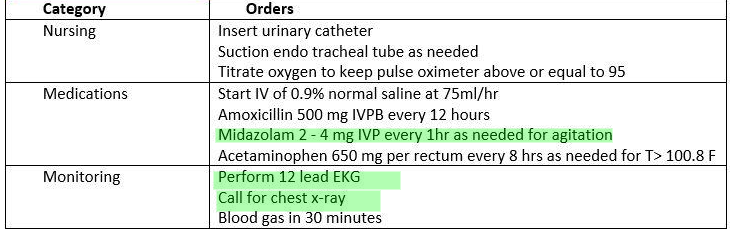
The Nurse receives orders. 
Click to highlight the 3 orders the nurse should implement first.


 Case Study Question 6 of 6

The nurse reassesses the client at 1000 and compares the findings to 0930.
For each finding, click to specify if the finding indicates that the client’s status has improved, declined, or is unchanged. Each row must have 1 option selected.

Answers: 
1. When asked about most urgent findings, think ABCs, in this case 4 are abnormal for breathing. 


2.  As you can see, you are not allowed to backtrack as you go along because the correct answers to the previous questions appear on the next one. 


3. The patient is going into acute respiratory failure necessitating intubation. 


4. Sedation is needed to control agitation in an intubated patient. Repeat xray is done to assess depth of the tube and document tube placement. Suctioning is done as needed (PRN). Amiodarone is not indicated unless patient has a refractory V-tach. Antibiotics are indicated for the pneumonia which is the cause of the patient's respiratory failure. Patient will be positioned with head elevated between 15 to 45 degrees to allow lung expansion. EKG is indicated in all critical patients.  


5. The 3 orders you will carry out first are chest xray for placement, midazolam for restlessness, and an EKG. Although the antibiotic is needed for pneumonia, it was ordered at a specific time as well as blood gas in 30 mins. Suctioning, and acetaminophen are ordered as needed. When answering questions looking for interventions to implement first, the PRN ones are not correct unless the scenario states that the indications for the PRN orders are present, in this case restlessness. The patient's oxygen saturation is at 96% so there's no need to titrate it at this time. The rest of the orders can be done later on. 


6.  The SPO2 went from 96% to 93%. The Temp remained unchanged. The other parameters improved.


Sources: 


All About Clostridium Difficile Infection (CDI). Please Read to Prevent Its Spread!


Clostridium Difficile Infection (CDI) is the most common healthcare-associated infection, causing half a million infections and an estimated 29,000 deaths. Protect yourself and your family.  

Risk Factors for CDI
Most cases of C. diff occur when you’ve been taking antibiotics.

There are other risk factors: • Being 65 or older • Recent hospitalizations • A weakened immune system • Previous infection with C. diff or known exposure to the germs. 


Symptoms of CDI

Symptoms can vary depending on the degree of inflammation in the colon, ranging from mildly loose stools to over twenty episodes of diarrhea per day. Abdominal pain and fever may also manifest.


In severe instances, a C. difficile infection can lead to potentially life-threatening complications such as dehydration due to excessive fluid loss from diarrhea, low blood pressure, toxic megacolon (markedly distended colon requiring surgical intervention), and colon perforation.


Precautions

Healthcare professionals, including nurses and doctors, need to strictly adhere to isolation protocols to prevent the spread of this infection. These protocols involve contact and enteric precautions:


  • Hand Hygiene: Healthcare providers and visitors should thoroughly wash their hands with soap and water before and after entering a patient's room, using the restroom, or moving between patients. Handwashing with soap and water is preferred over hand sanitizer for effectiveness.
  • Personal Protective Equipment: Healthcare workers and visitors should wear disposable gowns and gloves when interacting with infected patients. Gloves are necessary when handling potentially contaminated materials, while gowns should be worn if there's a risk of fecal soiling. Proper removal of gowns and gloves followed by hand hygiene is crucial before leaving the patient's room.
  • Room Placement: Ideally, patients with C. difficile should be isolated in private rooms with dedicated bathrooms. If private rooms are unavailable, patients can be grouped based on their C. difficile status.
  • Environmental Cleaning: All surfaces in healthcare settings should be thoroughly disinfected using chlorine bleach products since C. difficile spores can survive on surfaces even after standard cleaning.


Enhanced Barrier Precautions For Nursing Homes:

Enhanced Barrier Precautions (EBPs) involve using personal protective equipment (PPE) to minimize the transmission of multidrug-resistant organisms (MDROs) in nursing home settings. EBPs are implemented during high-contact resident care activities and entail wearing gowns and gloves for residents known to be infected with or colonized by MDROs or those at a heightened risk of acquiring them. This includes residents with wounds, indwelling medical devices, central lines, urinary catheters, feeding tubes, tracheostomies, or ventilators.

MDRO transmission is common in skilled nursing facilities, and can lead to increased healthcare costs, as well as significant resident morbidity and mortality. 

Sending Specimen for C Diff Testing

• Do NOT send stool for C. difficile testing without diarrhea (≥ 3 loose bowel movements in 24 hours).
• Do not send stool if there has been recent use of laxatives. Discontinue laxatives and consider testing if diarrhea continues beyond 48 hours and there is no alternative explanation for the diarrhea.
• Testing requires approval from the ID attending on-call.
• Do not send repeat specimens to document “test of cure.” The test can remain positive for weeks after treatment
• Do not repeat testing in patients who have undergone recent fecal microbiota transplantation (FMT) for the same reason (Fecal microbiota transplantation 0r FMT, commonly referred to as stool transplant, is a medical procedure wherein beneficial bacteria from a healthy donor are transferred to the colon of a recipient. The aim is to alter the microbial composition of the recipient's gut, offering potential health advantages. FMT is widely accepted as the preferred treatment for recurrent C. diff  infections.)


Antibiotic Therapy for CDI

 The Agency for Healthcare Research & Quality (AHRQ) has launched a fresh online initiative, the Safety Program for Enhancing Antibiotic Use, designed to enhance antibiotic usage across acute, long-term, and ambulatory care settings by strengthening antibiotic stewardship programs. The objective is to discontinue antibiotics whenever feasible. Antibiotic usage stands as the foremost risk element for CDI (Clostridioides difficile infection). Specifically, broad-spectrum antibiotics such as clindamycin eliminate a wide range of gut bacteria, many of which play crucial roles in human health.  

C diff treatment is based on the severity of symptoms. Below are some treatment guidelines followed by hospitals as recommended by Infectious Disease (ID) doctors. Always follow your hospital policy.

 Severity

Clinical Manifestations

Treatment

Asymptomatic colonization

Positive C. difficile test without diarrhea, ileus, or colitis

No treatment necessary

Non-severe

Positive C. difficile test with diarrhea and no manifestations of severe disease

Vancomycin 125 mg* every 6 hours PO/NGT for

10 days

(pre-approved)

Severe

Positive C. difficile test with diarrhea and ≥ 1 of the following attributable to CDI

·  WBC ≥ 15,000

· Serum Cr > 1.5 mg/dL


Vancomycin 125 mg* every 6 hours PO/NGT for

10 days

(10 days are pre-approved)

Consider GI consultation for Fecal Microbiota Transplantation (FMT) in patients without improvement on 5 days of therapy

Fulminant*

Criteria as above with ≥ 1 of the following attributable to CDI

· Hypotension

· Toxic megacolon

· Lactate ≥ 4

· ICU admission for severe disease


Vancomycin 500 mg PO/NGT every 6 hours

AND

Metronidazole 500 mg IV every 8 hours

If unable to tolerate oral therapy can consider Vancomycin retention enema (500 mg in 100 mL Normal Saline every 6 hours)

Please consult GI for Fecal Microbiota Transplantation (FMT)

Please consult ID and Surgery

(Note: There is a difference between infected and colonized by C Diff. Those who are infected are 'symptomatic". While those who are colonized are "asymptomatic" but still carry the organism in their system. Always observe handwashing and barrier precautions in both cases.)

Other treatment recommendations:

 Avoid use of anti-motility agents in patients with CDI.

 Avoid use of binding agents (e.g. cholestyramine) as they can bind oral vancomycin.

 If patient is not improving on vancomycin, other causes should be evaluated and/or FMT considered. Fidaxomicin is not to be used as a rescue medication if patient is not improving on vancomycin.

 Routine prophylactic use of metronidazole or oral vancomycin is not recommended. There may be specific situations where this is warranted and this should be discussed with ID.


Recurrent CDI

 Defined as episode of symptom onset and positive assay result following an episode of positive assay result in previous 2-8 weeks

 Resistance to either metronidazole or vancomycin has not been described.

 Recurrence occurs in approximately 25% of patients and can be due to failure to eradicate spores or acquisition of a new strain. The risk for recurrence increases with every bout of CDI.


I hope you learned something from this article and please check out the references below for more information about CDI. Thank you.


Please watch the YouTube videos that covers this topic: 


Clostridium Difficile Infection Lecture Part 1


Clostridium Difficile Infection Lecture Part 2


References:


https://apic.org/professional-practice/implementation-guides/


https://apic.org/resources/topic-specific-infection-prevention/clostridium-difficile/

Tuesday, June 4, 2024

Just Culture in Healthcare


Just Culture in Healthcare

The single greatest impediment to error prevention in the medical industry is “that we punish people for making mistakes.”   

- Dr. Lucian Leape Professor, Harvard School of Public Health Testimony before Congress on Health Care Quality Improvement


“People make errors, which lead to accidents. Accidents lead to deaths. The standard solution is to blame the people involved. If we find out who made the errors and punish them, we solve the problem, right? Wrong. The problem is seldom the fault of an individual; it is the fault of the system. Change the people without changing the system and the problems will continue.”

- Don Norman, Author, “The Design of Everyday Things


Traditionally, what happen to the staff who made an error? 

 coach or re-educate 

 formal written warning in their file

 immediate suspension until investigation complete

 termination


What is a Just Culture

A “Just Culture” is an open and fair culture in which all members of an organization are accountable, in a fair and just way, for making safe behavioral choices.


“Just Culture” strives to be the balance between “blame-free” and “punitive”.

The emphasis is to maintain individual accountability for unsafe behaviors, while acknowledging that most errors occur as a result of system flaws.

 Principles of Just Culture


It will require a Just Culture, where all staff feel comfortable reporting errors–including their own
 feel that their errors will be judged fairly
 feel they won’t get blamed and punished for system errors
 know about unsafe/risky choices and try not to make them
 know that Reckless and Disruptive Behavior is unacceptable

Behaviors that Undermine a Culture of Safety

Disruptive Behavior is any conduct or behavior including but not limited to, sexual harassment, 
ethnic or racial slandering, and/or any forms of unacceptable behavior

Unacceptable Behaviors includes:  Belittling criticism in front of other staff, patient, or visitor  Slamming or throwing of objects  Retaliation against any person for reporting a violation of the code of behaviors/policy

Not only are these behaviors unacceptable, but these behaviors also undermine a culture of safety. A staff person who has been criticized or belittled may not speak up when a next event happens.

THE JUST CULTURE PROCESS


References:

Quality & Safety: ‘Just Culture’ Provides Process to Review, Correct Mistakes for Optimal Patient Care | Department of Medicine (arizona.edu)

Management of Sepsis


Management of Sepsis


Sepsis is a critical medical condition caused by organ dysfunction due to an abnormal response to infection. 

The Goals of treatment are: 

 To reduce mortality in adult and pediatric patients with severe sepsis and septic shock by developing a protocol-based approach to case identification and rapid treatment. 

Rapid identification and communication regarding patients with sepsis, severe sepsis and septic shock. 

Treatment measures include: • Blood culture before antibiotics • Antibiotics • Lactate level • Fluid resuscitation • Use of vasopressors if persistent hypotension


Sepsis Definitions


Sepsis Bundles


Effectively managing sepsis and septic shock involves a team effort from healthcare professionals including doctors, nurses, patient care technicians, and pharmacists, among others, to improve patient-centered care and outcomes. 
The most effective way to reduce in-hospital mortality in sepsis patients is through early identification and prompt implementation of treatment bundles according to your hospital's protocols.

Sources: 

Severe Sepsis and Septic Shock: Management Bundle Measure (cms.gov)

Pearls and Pitfalls: CMS and Sepsis – CriticalCareNow

Sickle Cell Disease (SCD)

    Sickle Cell Disease (SCD) Sickle cell disease (SCD) is a collection of genetic blood disorders in which abnormal levels of hemoglobin, c...